





A routine metal-detecting outing along Norway’s central coast has led to the discovery of a rare and striking Viking Age grave, offering insight into burial practices in the area that took place more than 1,200 years ago.
The grave was discovered on a site in the North Atlantic coast of Trøndelag in central Norway and is believed to date back to as far as 850 CE, Raymond Sauvage, head engineer at the department of archaeology and cultural history at the Norwegian University of Science and Technology (NTNU), told Newsweek.
The discovery began when detectorist Roy Søreng, who has searched for metal artifacts in the area for the past couple of years, picked up an unusual signal. Søreng had previously found “several stray finds of Viking Age and medieval jewellery and coins” in the area, Sauvage told Newsweek. But this time, the discovery was different.
During one of his searches, Søreng “came upon a Viking Age oval brooch, where he could see that another similar brooch was still in situ in the same hole. This made him suspect that this could be an undisturbed grave and alerted the responsible archaeological institutions,” Sauvage explained. The report prompted a full excavation by archaeologists from the NTNU Science Museum and Trøndelag County.
The grave may have belonged to a married woman who held a respected position within her local farming community.
“We date the grave to c. 800–850 CE, based on the shape and ornaments on the oval brooches,” Sauvage said. He added that the burial is particularly significant because of the preservation of the remains.
“Since Norway often has acidic soils that do not preserve bones well, this discovery provided a rare glimpse into Viking Age mortuary practice [that] includes the skeleton. This is something we do not see often in Scandinavia.”
Two classic oval fibulas—brooches used to fasten Viking Age clothing—were found in place, securing the outer garment.
Nearby, another small ringed fibula was also discovered, possibly associated with an undergarment, according to a local media report.
The jewellery offers clues to her social role. “This could have been a person that stood out in the community, and that might have had ritualistic responsibilities. However, the jewellery also points to this being a married woman and possibly the mistress at the local farm,” Sauvage noted. “Oval brooches in burials are often seen as a sign that the deceased was married.”
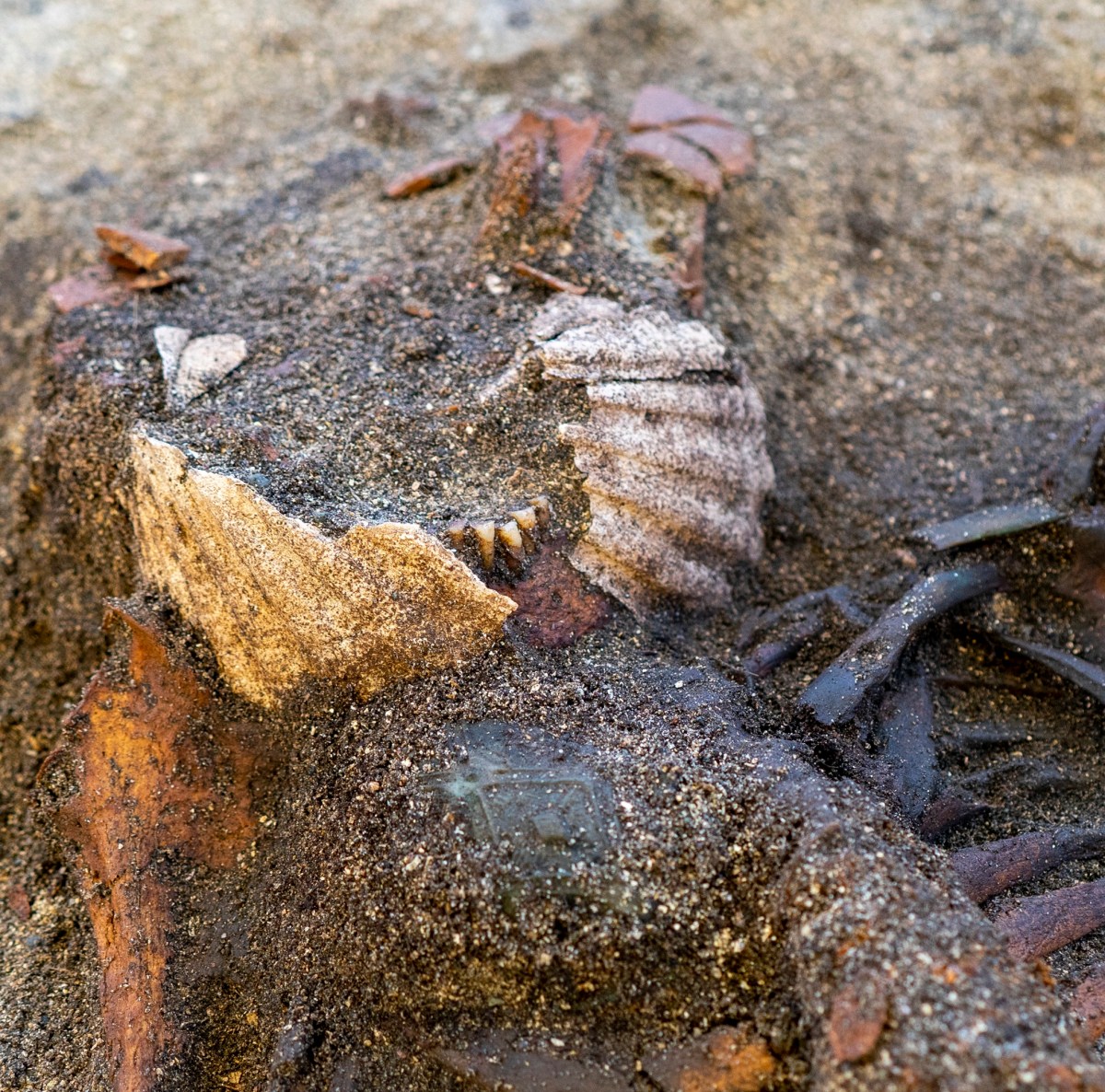
The grave is especially unusual because of the complexity of the burial ritual. “What makes the grave extra striking and rare is the fact that the skeleton was preserved, and also the unique glimpse into Viking Age mortuary behavior,” Sauvage explained, highlighting the placing of two scallop shells at the mouth of the deceased and lining the grave with wings from several birds.
The two shells were found positioned with their curved sides facing outward, their edges meeting as if forming a protective mask over the mouth. According to Sauvage, no similar burial motif is known from pre-Christian graves in Norway.
In addition to the shells, bird bones were discovered carefully arranged within the grave. Researchers say the combination points to a unique burial ritual. According to the local media report, the objects may reflect the deceased’s status, identity or spiritual beliefs.
“It is the preservation and the unique insight into burial practice that makes this find stand out,” Sauvage explained. “The practice of burying the dead with two scallops near the mouth and lining the grave with bird wings is something that we have not seen before.
“This tells us that this was a person who was provided with a burial ritual that displayed special objects that must have had some meaning to the beholders of the funeral.”
Although the precise meaning of the burial remains uncertain, the archaeologists believe that “this must have been a person that stood out in the local community–perhaps someone related to fertility rituals or similar,” Sauvage said.
“Scallops may be related to fertility symbolism, as seen in classical art, but are also related to the pilgrimage of Saint James in southern Europe. The bird wings must also have added a striking dimension to the ritual,” he added.
Do you have a tip on a science story that Newsweek should be covering? Do you have a question about archaeology? Let us know via science@newsweek.com.
Read the full article here